Proteins that read DNA sequences control gene expression, DNA repair, and chromosome maintenance, making the protein–DNA interface a compelling target for chemical intervention. Most current tools work by blocking this interface with small molecules, or by competing with it with modified oligonucleotides, the so-called DNA decoys. A distinct class of synthetic molecules called DNA mimic foldamers takes a different approach: single-stranded aromatic oligoamides bearing anionic phosphonate side chains fold into helices whose surface charge distribution matches that of B-DNA, allowing them to bind and in some cases outcompete DNA for protein partners. Until now, these foldamers consisted of a repeating MQ4 dimer unit, giving them a uniform groove analogous to a featureless poly(dA:dT) duplex. That homogeneity has blocked their use against sequence-selective DNA-binding proteins such as transcription factors and restriction enzymes, whose recognition involves base-specific contacts in the DNA major groove.
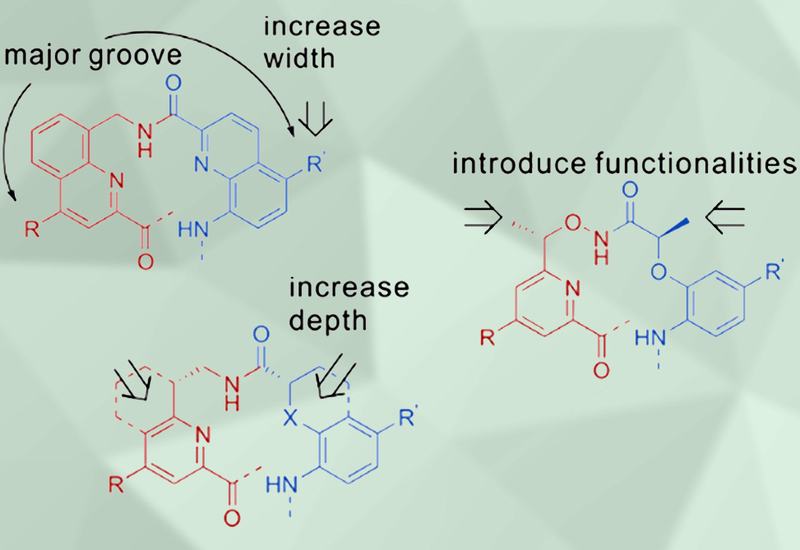
Researchers in the Huc Group at Ludwig-Maximilians-Universität München, as published in Chemical Science, designed and synthesized four new Fmoc-protected amino acid monomers intended to diversify the chemistry displayed in the major groove of DNA mimic foldamers. The four monomers, designated H, O, N, and BP, are structural analogues of the existing M and Q4 building blocks and were conceived to widen or deepen the major groove, introduce hydrogen-bond donors and acceptors, and modulate helical flexibility. Each was prepared in four to five synthetic steps and characterized in Fmoc-protected form for solid-phase synthesis. Sixteen foldamer sequences were then assembled on solid phase and studied by NMR, circular dichroism, molecular modeling, and X-ray crystallography. Biolayer interferometry, BLI, assessed binding to the bacterial histone-like protein HU.
X-ray crystal structures confirmed that monomers O and H adopt conformations consistent with their design and preserve helical architecture. Monomer O, which carries a hydroxylamine methylene group, showed variable torsion angles across four independent molecules in the asymmetric unit, quantitatively demonstrating enhanced conformational flexibility as designed. Monomer H proved more complex: NMR spectra of H-containing sequences revealed two interconverting conformers attributable to distinct gauche states of the acylhydrazide N–N bond, one of which promotes a local reversal of helix handedness. That ambivalent behavior rendered H unreliable for predictable groove engineering. Monomer N, a rigid imidazole-containing analogue of M, gave a single set of NMR signals, indicating a stable, well-defined conformer. Notably, a sequence bearing three BP units formed a discrete aggregate at higher concentrations, a behavior not previously observed in M- or Q-containing segments and flagged as a potential new self-assembly mode.
Quantitative helix handedness inversion kinetics, measured by monitoring circular dichroism band buildup after dissolution from a DMSO/water equilibration mixture, ranked the new monomers by their contribution to conformational dynamics. A BP-containing sequence showed a t1/2 of helix handedness inversion of 30 min at pH 5.5, compared with a reference sequence whose kinetics were too slow to measure at 25 °C. Sequences bearing O and H were faster still, with t1/2 values of 4.2 min and 1.2 min, respectively, while the N-containing sequence was nearly indistinguishable from the reference, at 18 min. BLI sensorgrams for binding to the HU homodimer showed that all modified foldamers retained nanomolar affinity. The BP-containing variant bound with a KD of 59 nM, approximately two-fold tighter than the parent sequence at 100 nM, while N- and O-containing variants fell between 171 and 296 nM.
These results establish a toolkit for encoding chemical sequence information directly into the main chain of DNA mimic foldamers, a design challenge distinct from the side-chain variation that dominates both biopolymer and synthetic foldamer engineering. Three of the four monomers perform as designed without disrupting HU recognition, and the observed two-fold affinity gain with BP suggests that groove-shape tuning can influence protein binding. The authors propose that combining these new monomers with existing palindromic and chiral design principles will deliver foldamers capable of selective recognition of the α-helices that transcription factors use to read base-pair sequences in the DNA major groove, broadening DNA mimic foldamers from shape-selective to sequence-selective protein targeting.